

AI agents make autonomous work feel inevitable. But beneath the promise of infinite digital labor, task costs rise, trust becomes fragile, and the organization itself becomes the bottleneck. That is the paradox of agent-centric economics.
The elephant in the dark room
There is an old Persian story, often told through Rumi, about an elephant placed in a dark room.
People enter the room one by one. One touches the trunk and says the creature is like a pipe. Another touches the ear and calls it a fan. Another touches the leg and believes it is a pillar. Each is right in contact, but wrong in conclusion.
They do not lack experience.
They lack light.
The same is happening with AI agents.
Technologists touch capability and see a revolution in software. CFOs touch compute spend and see a cost problem. CIOs touch security and see uncontrolled risk. Employees touch productivity and see relief from repetitive work. Vendors touch usage volume and see a new platform economy. Regulators touch autonomy and accountability, and see a governance problem before the market has even agreed what the object is.
Each perspective is partly true.
But none of them is the elephant.
The agent-centric economy is not one thing. It is a system of feedback loops between intelligence, task cost, trust, autonomy, infrastructure, human skill, and organizational readiness.
At first, this looks like a paradox: the cheaper intelligence becomes, the more expensive reliable work may become. But for organizations, it is experienced less as a paradox than as a dilemma. They must grant agents enough freedom to create value, while limiting that freedom enough to preserve trust, security, and economic control.
And once reliable work becomes the scarce resource, the whole system begins to behave differently.
When software starts acting, economics changes
Traditional software waits.
Agents act.
They plan, search, call tools, read context, generate outputs, and sometimes execute decisions. They do not merely support the worker. They begin to perform pieces of the work itself.
That is the economic shift.
But work has never been made of tasks alone. It is also made of trust, context, responsibility, permissions, tacit knowledge, and architecture — all the invisible structures that allow an action to be safe, meaningful, and economically worthwhile.
The first illusion: cheap tokens mean cheap work
The first trap is obvious and seductive. Tokens get cheaper, therefore AI work gets cheaper.
That feeling is not entirely wrong. At the local level, token prices matter. Cheaper inference lowers the cost of experiments. It allows more calls, more drafts, more reasoning, more parallel execution. It makes intelligence feel abundant.
But the system-level question is different.
Cheaper at what?
Cheaper tokens are not the same as cheaper business outcomes. A token is not a task. A task is the full cost of reaching a reliable result. It includes planning, retries, tool calls, validation, supervision, integration, security, exception handling, and sometimes human review.
What disappears from the generation phase often reappears in the reliability phase.
And reliability does not scale as easily as generation.
You can multiply agent output with cheaper tokens. You cannot multiply trust, data readiness, governance, and organizational clarity at the same rate.
That is where the illusion begins.
The second illusion: demand will be satisfied
A second fantasy follows close behind the first. If agents make tasks cheaper, surely organizations will finally catch up. Backlogs will shrink. Routine work will disappear. The machine will absorb the excess.
But cheaper execution rarely ends demand. It usually unlocks more of it.
When the cost of agentic work falls, organizations do not become quiet. They become more ambitious. More workflows are considered automatable. More reports become worth generating. More checks become worth running. More experiments become worth trying. More “not worth the effort” becomes “why not let an agent do it?”
The firehose does not relieve the system. It enlarges it.
This is the Jevons paradox of tokens.
As token costs fall, task costs can fall. As task costs fall, agent-performed work expands. As agent-performed work expands, compute spend rises. As compute spend rises, more infrastructure is built. More infrastructure may then reduce token costs again.
At first, this looks like a virtuous cycle.
But the loop has a shadow. Lower unit costs can increase total consumption. The organization may feel more automated and more overwhelmed at the same time.
It is not escaping the loop. It is deepening it.
The third illusion: intelligence can flow through broken canals
There is a more dangerous assumption beneath many agent strategies.
It is the belief that enough intelligence can compensate for weak structure.
Many enterprises will try to pour agents into systems that were never designed for agentic work. Their data is fragmented. Their APIs are incomplete. Their permissions are human-centered. Their process logic is implicit. Their documentation is outdated. Their most important knowledge lives in exceptions, habits, inboxes, spreadsheets, and the memory of experienced people.
Imagine an ancient desert empire discovering an underground ocean.
The Emperor orders the construction of Grand Canals to automate the farming of the realm. At first, the water flows beautifully. Fields flourish. Villages celebrate. The empire begins to believe that abundance has finally become an engineering problem.
But then the soil resists.
The ground is full of embedded rocks. The old channels are crooked. The farmers do not know how to route the water safely. Some begin digging hidden trenches at night to bypass the official gates. The Master Hydrologists, desperate to guarantee perfect crops, build enormous filtration engines. Every drop is purified, checked, routed, and checked again.
The crops improve.
But the pumps become ruinously expensive.
To avoid bankruptcy, the empire raises the tax on every drop. Soon a farmer looks at the new decree, drops his shovel, and walks away from the grand automated canal. He returns to a muddy local well. It is less impressive, but it is affordable, nearby, and under his control.
This is not a story about water.
It is a story about agent-centric economics.

The water is intelligence. The rocks are legacy systems. The canals are APIs and workflows. The hidden trenches are shadow AI. The filtration engines are inference-time compute. The taxes are effective AI prices. The local wells are open-source and local models.
The empire’s mistake was not ambition. It was believing that more water could solve unprepared soil.
Many organizations are about to make the same mistake with AI.
The systemic law is simple:
Intelligence cannot flow faster than the structure that receives it.
This is why enterprise data readiness and software API readiness are not technical housekeeping. They are economic infrastructure. Clean data, exposed capabilities, machine-readable context, semantic layers, and well-defined permissions reduce the amount of thinking an agent must waste on orientation.
A prepared organization makes intelligence cheaper.
An unprepared organization makes intelligence burn.
The physical return of the digital world
The agent economy often sounds weightless.
Tokens. Models. APIs. Agents. Workflows. Context windows. Reasoning traces.
The vocabulary is abstract, but the substrate is physical. Data centers need land, electricity, cooling, chips, capital, grid connections, and time. Inference may feel like a service, but it is also an industrial activity.
This matters because the reinforcing loop of agentic demand eventually meets a balancing force.
More agent work drives more compute spend. More compute spend funds more compute capacity. More compute capacity can lower token costs. But more compute capacity also increases pressure on power grids, cooling systems, hardware supply chains, and capital budgets.
At some point, energy and infrastructure costs set a floor.
The dream of infinitely cheap intelligence runs into the stubborn reality of the world that must produce it.
The cloud still has weight.
The reliability tax
There is another cost hidden inside the agent promise.
Reliability.
A demo can be charming at eighty or ninety percent. A production workflow cannot always afford that luxury. A customer communication, payment instruction, compliance check, database update, or operational decision may require a very different standard.
The closer we move toward high reliability, the more inference-time compute may be needed. Agents must plan, check, retry, call tools, compare alternatives, criticize their own outputs, simulate edge cases, and sometimes ask other agents or humans to verify the result.
This is useful.
It is also costly.
A task that looks cheap when an agent answers once may become expensive when the agent must become trustworthy. The cost curve is not always linear. The last few percentage points of reliability may require a disproportionate amount of reasoning, validation, and orchestration.
This is the reliability tax.
It is the price of moving from impressive output to dependable work.
The subsidy trap
Much of today’s AI experience is shaped by an unusual economic moment.
Powerful systems are available at prices that may not fully reflect the total cost of frontier model development, inference infrastructure, capital expenditure, and service operation. Users learn to expect abundance before the market has fully revealed the cost of supplying it.
That can create a fragile adoption curve.
When agents move from occasional assistance to continuous operation, usage patterns change. Agents do not only answer questions. They run loops. They reason before acting. They call other services. They retry. They monitor. They may create small payments to access data, tools, APIs, and compute resources.
A machine-to-machine economy of micro-transactions begins to appear.
But if agentic demand grows faster than providers can serve it profitably, the system must adjust. Prices rise. Rate limits tighten. Quality tiers become more visible. Smaller models may be routed into tasks that once received stronger models. Tokenization and packaging may obscure the real price of work.
The advertised price can remain stable while the effective price rises.
And when the effective price rises, substitution ROI weakens.
The agent may still be capable. It may still be impressive. It may still be useful. But it may no longer be cheaper than the human process it was supposed to replace.
That is where the economics begin to bite.
The open-source escape
When effective AI prices rise, heavy users will not simply accept them.
They will route, cache, compress, specialize, and substitute. They will use smaller models for smaller tasks. They will run local inference where data sensitivity or cost intensity justifies it. They will combine proprietary frontier models with open-source or self-hosted systems. They will discover that not every workflow needs the most powerful model available.
This is the open-source escape hatch.
It is not a romantic rejection of frontier AI. It is portfolio logic.
Some tasks require frontier reasoning. Some require domain context. Some require low latency. Some require privacy. Some require cost predictability. Some require nothing more than a small, reliable model operating inside a well-structured workflow.
In an agent-centric economy, the strategic question is no longer simply:
Which model is best?
It becomes:
Which combination of model, data, workflow, governance, and cost structure produces the best outcome?
Intelligence becomes an architectural allocation problem.
The disappearing human capability
The most overlooked bottleneck is not technical.
It is the human ability to describe work precisely.
Agents increase the value of people who can formulate goals, constraints, dependencies, exceptions, decision rules, and quality criteria. Not vaguely. Not inspirationally. Operationally.
This is not programming in the narrow sense. It is algorithmic thinking.
It is the ability to turn intention into executable structure.
As agents become more capable, many organizations will discover an uncomfortable gap. The technology can do more than the workforce can clearly ask it to do. Business users know the desired outcome but cannot specify the path. Technologists can build the path but often lack the domain nuance. Managers want productivity but underestimate the design work required to make delegation safe.
The result is a capability skill gap.
Projects stall. Pilots remain impressive but isolated. Agents are either underused or overtrusted. IT becomes a bottleneck. Consultants become translators. The organization mistakes access to intelligence for the ability to use intelligence.
That is why reskilling cannot be reduced to prompt training.
The deeper skill is systems thinking. Process thinking. Data thinking. Boundary thinking. Feedback thinking.
The future may not belong to those who merely use agents.
It may belong to those who can architect the conditions under which agents become useful.
The trust trap
Institutional trust behaves asymmetrically.
It is built slowly and destroyed quickly.
When agents succeed repeatedly, confidence grows. A manager approves a larger use case. A team delegates another workflow. A compliance function accepts a bounded experiment. Slowly, autonomy increases.
But autonomy expands the surface area of risk.
Agents with write access, budget authority, shared context, and cross-system permissions can fail in ways that are not merely wrong but consequential. A data leak, a mistaken transaction, an unauthorized action, or a cascading workflow error can destroy months of accumulated confidence.
This creates a brutal balancing loop.
Trust enables autonomy. Autonomy increases risk. Risk destroys trust. Destroyed trust reduces autonomy.
The lesson is not that agents should never be autonomous.
The lesson is that autonomy must be earned structurally.
It must be bounded, observable, reversible, and proportional to the reliability of the task. The goal is not maximum autonomy. The goal is appropriate autonomy.
The shadow AI paradox
The instinctive answer to risk is restriction.
Block the tool. Limit the model. Ban the account. Add approvals. Close the gate.
Sometimes this is necessary. But when restriction becomes detached from real work, it creates a second system beneath the official one.
People still need to deliver. If the sanctioned path is too slow, too weak, or too disconnected from reality, they will find another path. Personal accounts. Browser extensions. Local models. Copied data. Screenshots. Unlogged prompts. Informal workflows.
The organization then loses visibility.
The policy designed to reduce risk increases hidden risk.
That is the shadow AI paradox.
The answer is not naive openness. It is paved-road governance. Safe internal tools. Monitored gateways. Clear data rules. Cost controls. Usable model access. Practical support. Auditability that does not make work impossible.
Governance succeeds when the safe path is also the easy path.
The real shift
The deeper lesson is not that agents should be rejected. It is that work must be re-understood.
We are moving into a world where intelligence is more abundant, but reliable autonomous work remains scarce. In such a world, the core capability of an organization is not merely the ability to buy models or deploy agents. It is the ability to make work legible enough, structured enough, and governed enough for agents to perform it safely and economically.
That means treating data readiness as infrastructure.
It means treating APIs as economic channels.
It means measuring task cost, not only token cost.
It means protecting trust as a scarce organizational asset.
It means teaching people to formulate work, not only consume outputs.
It means refusing to confuse autonomy with value.
Above all, it means remembering that an organization is not a prompt field. It is a living system of people, memory, rules, tools, incentives, exceptions, and consequences.
When that system is unprepared, agents can still appear productive for a while.
And that is the paradox: we climb higher on the ladder of autonomous work, while the ground of trust, structure, and economic viability beneath us slowly gives way.
The more AI helps software act on our behalf, the more carefully we must build the conditions that make those actions worth trusting.
The final strategic claim: the future does not belong simply to organizations that deploy more agents. It belongs to organizations that make work legible, structured, and trustworthy enough for agents to perform it economically.
Authors Note on System Thinking
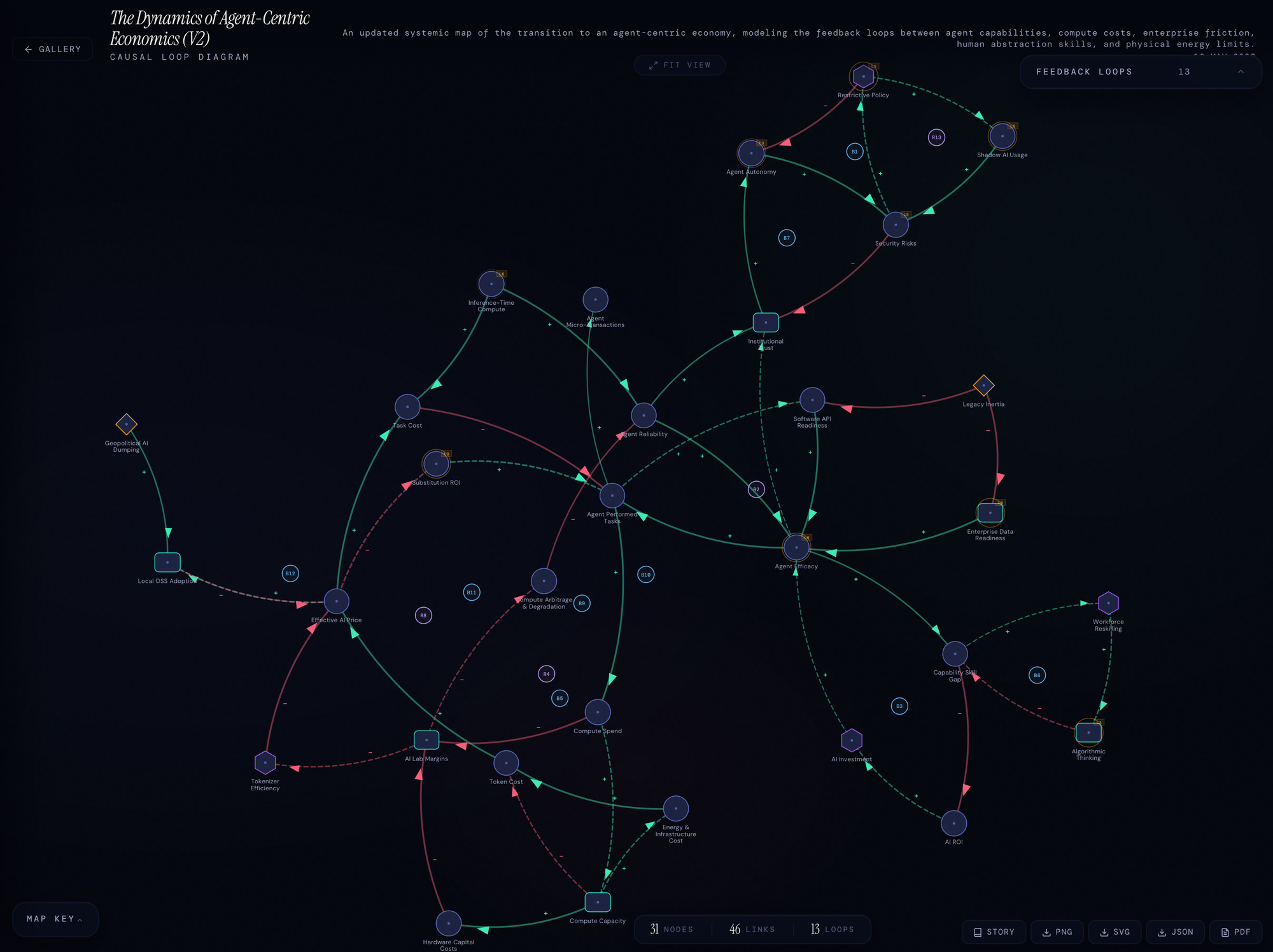
Over the past weeks, I have tried to understand the emerging agent economy not as a trend, but as a system. I mapped the relationships between agent efficacy, task cost, compute spend, enterprise readiness, trust, autonomy, shadow AI, open-source adoption, and the physical limits of infrastructure.
What emerged was not a story about automation alone, but a deeper paradox: the easier autonomous work becomes to imagine, the more visible the hidden economics of reliable execution become.
Systems thinking helped me see that more clearly. The causal loop diagram behind this article traces reinforcing loops, balancing forces, delays, and leverage points beneath the surface of agent adoption. It shows why cheap tokens may produce expensive tasks, why restrictive governance can create shadow usage, why open-source models become an economic escape hatch, and why the real leverage may lie in enterprise readiness rather than model capability alone.
If this article feels close to something you are observing in your own organization, I would be glad to continue the conversation..
Selected references and notes
This article is based on a causal loop model created for The Dynamics of Agent-Centric Economics. The model contains 31 nodes, 46 causal links, and 13 feedback loops, including the Agentic Virtuous Cycle, Jevons Paradox of Tokens, Physical Energy Wall, Trust Vaporization, Subsidy Collapse, Open Source Escape Hatch, and Shadow AI Paradox.
Core system lens
William Stanley Jevons — The Coal Question (1865). Why it matters: the classic foundation for the article’s “Jevons Paradox of Tokens” — cheaper units can increase total consumption.Link: https://oll.libertyfund.org/titles/jevons-the-coal-question
Donella H. Meadows — Thinking in Systems (2008). Why it matters: conceptual basis for stocks, flows, delays, reinforcing loops, balancing loops, and leverage points.Link: https://www.chelseagreen.com/product/thinking-in-systems/
Jay W. Forrester — Industrial Dynamics (1961). Why it matters: foundational work behind system dynamics and feedback-driven economic behavior.Link: https://mitpress.mit.edu/9780262560018/industrial-dynamics/
Persian metaphor
Jalal ad-Din Rumi — Masnavi, Book III, “The Elephant in the Dark Room”. Why it matters: the opening metaphor for partial perception — every actor touches one part of the agent economy and mistakes it for the whole.Link: https://www.dar-al-masnavi.org/n.a-III-1259.html
AI infrastructure and physical limits
International Energy Agency — Energy and AI (2025). Why it matters: supports the article’s claim that AI is becoming an energy and infrastructure question, not only a software question. The IEA projects data-centre electricity consumption to roughly double by 2030 in its base case.Link: https://www.iea.org/reports/energy-and-ai/energy-demand-from-ai
Goldman Sachs Research — AI to drive 165% increase in data center power demand by 2030 (2025). Why it matters: supports the “physical energy wall” argument and the return of physical constraints in digital economics.Link: https://www.goldmansachs.com/insights/articles/ai-to-drive-165-increase-in-data-center-power-demand-by-2030
Inference, reliability, and task cost
Stanford HAI — AI Index Report 2025. Why it matters: broad evidence base for AI progress, hardware trends, inference-cost dynamics, and economic impact.Link: https://hai.stanford.edu/ai-index/2025-ai-index-report
SWE-bench — Real-world software engineering benchmark. Why it matters: useful signal for the gap between impressive benchmark progress and reliable real-world task execution.Link: https://www.swebench.com/
Security, autonomy, and shadow AI
OWASP — Top 10 for Large Language Model Applications. Why it matters: supports the sections on prompt injection, sensitive information disclosure, excessive agency, unbounded consumption, and model/system misuse.Link: https://owasp.org/www-project-top-10-for-large-language-model-applications/
OWASP — Top 10 for Agentic Applications 2026. Why it matters: directly related to autonomous agents: goal hijacking, tool misuse, identity and privilege abuse, supply-chain issues, memory/context manipulation, and cascading failures.Link: https://genai.owasp.org/resource/owasp-top-10-for-agentic-applications-for-2026/
Regulation and governance
European Commission — EU AI Act. Why it matters: supports the line that regulators “touch autonomy and accountability” and see a governance problem.Link: https://digital-strategy.ec.europa.eu/en/policies/regulatory-framework-ai
European Commission — General-Purpose AI Code of Practice. Why it matters: relevant to model-provider obligations, transparency, safety, security, and systemic-risk governance.Link: https://digital-strategy.ec.europa.eu/en/policies/contents-code-gpai
NIST — AI Risk Management Framework: Generative AI Profile (AI 600-1). Why it matters: useful governance reference for managing generative AI risk as an organizational discipline rather than a purely technical problem.Link: https://www.nist.gov/itl/ai-risk-management-framework
Article thesis in one note
The article’s central distinction is between token cost and task cost. Token cost measures the price of generation. Task cost measures the total cost of producing a reliable business outcome — including reasoning, retries, validation, supervision, integration, governance, security, and trust.
Last edited: Mai 17, 2026