

TL;DR
Most companies think AI adoption is about tools. It isn’t.
AI exposes a deeper truth: you can’t outsource imagination.
When models and tooling become commoditized, the real constraint shifts to people, culture, and permission.
Organizations that win with AI won’t be those with the best dashboards — but those that enable intrapreneurs to build, experiment, and verify outcomes directly.
AI-native products are probabilistic, not deterministic.
The human role moves from manual creation to judgment, taste, and verification.
The decisive advantage is not the model — it’s the habitat you build around it.


Why intrapreneurship, and not tools, will decide who actually re-imagines products
For years, corporate innovation has quietly drifted into a strange corner.
Companies say they are “adopting AI,” but what they often mean is buying software that happens to contain AI. Another tool. Another license. Another dashboard.
What they are not doing (at least yet) is re-learning how to build, how to re-imagine their products.
AI is now forcing a reckoning.
Not because it is “smarter.”
Not because it is cheaper.
But because it exposes something uncomfortable: You can not outsource imagination.
The Flute Without Breath
The 13th century poet and mystic Rumi opens the Masnavi with the image of the Ney, the reed flute. Its sound is haunting, intimate, almost alive. And yet Rumi reminds us:
The music does not come from the flute. It comes from the breath.
The flute is hollow. Without breath, it is silent.
AI today is very much that flute.
The models are powerful. The code is elegant. The tooling is astonishing.
But without human intent, without direction, taste, judgment, and courage, AI produces noise—not music.
For decades, organizations obsessed over the wood: programming languages, frameworks, platforms, architectures. Now the wood is nearly perfect. The constraint has shifted.
The real question for leadership is no longer “How good is our tech?”
It is:
“Is our organization capable of breathing meaning into it?”
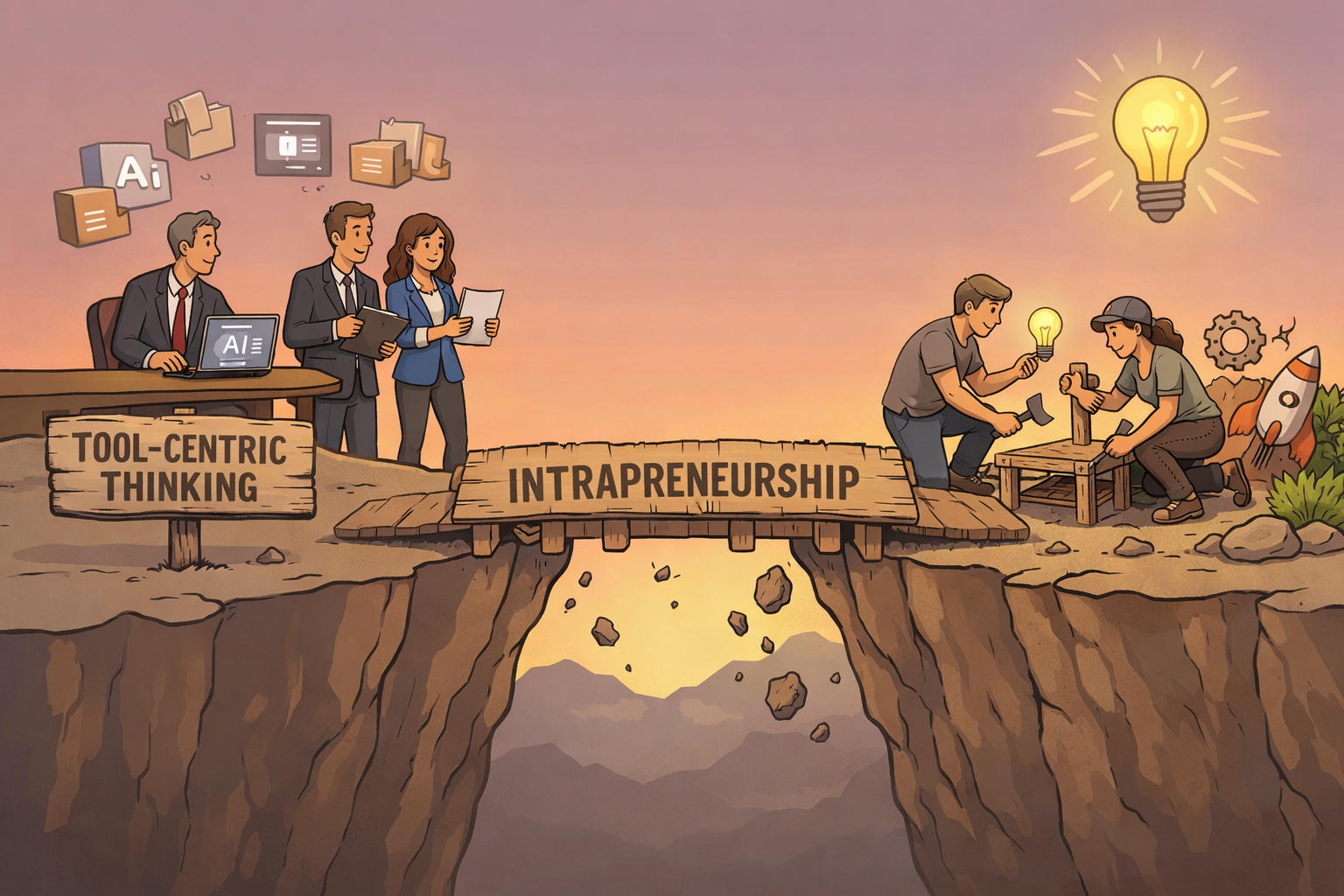
This is not a technology problem. This is an intrapreneurship problem. This is where cooperate innovation capabilities become existential. (We use the terms intrapreneurship and habitat deliberately; definitions follow at the end.)
The Real Shift: From IT Projects to Building Products Again
AI adoption is often framed as “plugging in tools.” That framing is already outdated. AI-native innovation requires a structural shift in how corporations imagine, build, and manage products.
Somewhere along the way, many companies outsourced their imagination.
IT projects slowly turned into procurement exercises. Innovation became vendor selection. Strategy decks ended with: “And then we integrate Tool X.”
This is not an argument against tools, commoditized layers should be bought, but a reminder that the layers that differentiate your product, encode judgment, and shape outcomes must be built as organizational capability, not procured as software.
This distinction matters most at the core. Buying AI for non-core functions like conversational interfaces or horizontal tooling is often rational. But when AI becomes part of how a company creates value, capability must be built, not rented.
AI breaks this pattern of outsourcing imagination for our core function. At least if we let it.
Because for the first time in decades, the person who understands the problem best can also build the solution.
Not perfectly. Not alone. But directly.
This is the real shift:
- From IT-led innovation
- To expert-led innovation
The bottleneck dissolves.
A domain expert no longer needs to wait six months for a prototype. With AI agents and vibe coding, they can sketch reality themselves. Fast, rough, and alive.
The better question is no longer: “What can this tool do for us?”
But:
“If you could build a custom software engine for your domain today what would it look like?”
That question changes everything.
Innovation Needs a Habitat, Not a Chatbox

Most companies trap AI in a chat window.
That is like inviting a world-class musician into your company — and asking them to hum quietly in the hallway.
The real value of AI is not the model. It is the habitat you build around it.
Real value emerges when AI lives inside the habitat of the organization:
- Behavioral data, especially from clients
- internal data
- proprietary workflows
- historical decisions
- undocumented tribal knowledge
The model itself is not the asset. The environment you build around it is.
In practice, this might look like an AI system embedded directly into claims handling, collections, compliance review, or customer support — connected to live behavioral data, historical decisions, and internal heuristics — where agents propose actions and humans verify, correct, and refine outcomes in real time.
Just as factories once embodied industrial advantage, AI habitats now encode competitive advantage. This is where un-monetized domain knowledge finally becomes operational.
Build a Proprietary AI Habitat where agents are residents, not guests.
This is how you turn decades of un-monetized domain knowledge into living product intelligence.
From Deterministic Products to Probabilistic Outcomes
Traditional products are deterministic: Click A → Get B.
AI-native products are probabilistic: Ask A → Receive B-ish.
This is not a bug.
It is the feature.
Probabilistic systems require verification by design — not because they are unreliable, but because they are generative.
The real UX shift
- Old UX: Manual input
- New UX: Outcome verification
Example:
- Before:
A marketer fills out a strategy template for four hours. - After:
AI generates ten strategies from live market signals.
The human becomes Editor-in-Chief.
The critical skill is no longer producing the first draft, but knowing what to question, what to trust, and what to discard.
This requires a deep mindset shift.
The product is no longer a template. It is a generator. Verification replaces manual creation.
This is uncomfortable for organizations built on control.
But it is currently the only way to scale intelligence.
AI doesn’t eliminate responsibility—it moves it up the stack.
And management must optimize for verification literacy, not button mastery.
Stripping Away Accidental Complexity
Most enterprise products are bloated.
Not because customers asked for it, but because humans had to do everything manually.
AI allows a brutal but necessary question:
Which 80% of our features exist only because humans used to do the work by hand?
When intent becomes the interface, products collapse back to their essence:
- A bank’s product is not a menu tree—it’s financial health.
- A CRM is not data entry—it’s relationship memory.
- A marketing tool is not templates—it’s strategic narrative.
Intrapreneurship means daring to ask:
“Which 80% of our features only exist because we didn’t have AI before?”
And having the authority, organizational as well as cultural, to actually remove them.
And having the courage to delete them.
Turning Hidden Expertise into New Products
Large organizations are full of niche brilliance.
Experts who solved problems no one ever productized because the market seemed “too small.”
AI changes the economics.
Internal venture studios can emerge naturally:
- a supply-chain expert builds a micro-tool
- a compliance lead encodes judgment into an agent
- a marketing strategist creates a generator, not a template
What starts as an internal aid can become a new external product.
Intrapreneurship is no longer about big bets.
It’s about many small, fast, contextual experiments.
In practice, this means that large organizations must learn to operate small, autonomous teams internally. Structurally closer to startups than departments. These teams need clear ownership, direct access to data and tools, and fast verification loops. Not to mimic startup culture but to recreate the conditions under which ideas can be tested, refined, and either scaled or discarded without friction.
That is corporate innovation done the startup way:
fast, experimental and close to reality
The Real Skill Shift: From Construction to Architecture
When AI handles syntax, libraries, and support structures, the human transforms and has to move up the abstraction ladder.
The premium skills are no longer:
- language fluency
- framework memorization
They become:
- clarity of intent
- computational thinking
- verification literacy
English is becoming the fastest-growing programming language—but only for those who can think precisely.
Managers, too, must evolve.
Their role shifts from resource allocation to habitat design:
- orchestrating multi-agent workflows
- deciding autonomy vs. control
- designing verification loops
- reducing organisational friction
This is not softer management.
It is harder, more conceptual, more consequential.
-> Stop tool shopping. Build environments.
-> Empower vibe coders, not ticket writers.
-> Simplify the organisation. Focus on outcomes.
-> Design for verification, not control.
The Managerial Shift: From Resource Management to Habitat Design
This shift does not make managers less important, it makes their decisions more consequential.
The new hierarchy is already visible:
- AI Agents handle execution
- Vibe Coders supervise intent and output
- Innovation Managers architect environments and risk
- Leaders define principles, culture, and moral direction
AI-native management asks:
“How should humans and agents collaborate?”
Managers now design:
- Multi-agent workflows
- Autonomy vs. risk profiles
- Human-in-the-loop scaffolding
They become architects of innovation systems, not task distributors.
Culture Is the Final Moat
When everyone has access to the same models, what remains defensible?
- Principles
- Taste
- Empathy
- Courage to experiment
In short: culture.
The leader’s role is no longer to control innovation but to keep the breath alive.
Not lazy prompting.
Not blind automation.
But curious, responsible intrapreneurship.
When tools become abundant, meaning becomes scarce and leadership is the practice of protecting meaning.
Back to the Flute
AI will not save organizations from irrelevance. But it will expose those that have forgotten how to breathe.
Intrapreneurship is not a “nice to have” for AI adoption.
It is the missing layer.
Without it, AI is just a beautifully crafted flute but perfectly silent.
The question is no longer whether your company has AI.
The question is whether it still knows how to make music.
If you found this perspective valuable, be sure to subscribe to Wismodia for monthly visionary articles that help you navigate and lead in the future that's unfolding. Together, let's build the future, one data factory at a time.
Terminology Note
Habitat vs. Factory
In this article we use AI Habitat instead of “AI Factory” intentionally.
A factory assumes the product is known and optimizes for efficiency and control.
A habitat creates the conditions for emergence, exploration, and adaptation.
AI-native innovation is non-linear and probabilistic.
Outcomes are discovered, not executed — through co-evolution of humans, agents, and knowledge.
Intrapreneurship vs. Corporate Innovation
We speak of intrapreneurship, not abstract “corporate innovation.” Innovation happens when individuals take ownership, experiment, and care about outcomes — not in programs or slide decks.
AI lowers the cost of experimentation, shifting the bottleneck from technology to permission.
Intrapreneurship is the capability that lets people act like founders inside the firm, supported by a shared habitat, clear principles, and verification loops.
References & Further Reading
Philosophy & Metaphor
- Rumi (Jalāl ad-Dīn Muhammad Rūmī) — Masnavi, “The Song of the Reed” (Ney)
The opening of the Masnavi, using the reed flute as a metaphor for meaning arising from breath rather than form. https://www.dar-al-masnavi.org/reedsong.html
Stop outsourcing imagination / It’s time to build
(cultural critique of procurement-as-innovation)
-
Marc Andreessen — It’s Time to Build
Essay arguing for rebuilding institutional capacity to create, not just optimize or procure. https://a16z.com/its-time-to-build/ -
Melvin E. Conway — Conway’s Law
The principle that system design mirrors organizational communication structures. https://en.wikipedia.org/wiki/Conway%27s_law
Intrapreneurship & Innovation Inside Organizations
-
Gifford Pinchot III (1985) — Intrapreneuring: Why You Don’t Have to Leave the Corporation to Become an Entrepreneur
Foundational work defining intrapreneurship as entrepreneurial ownership within large organizations. https://papers.ssrn.com/sol3/papers.cfm?abstract_id=1496196 -
Wikipedia — Intrapreneurship
Concise overview of the concept, its history, and its evolution in corporate contexts. https://en.wikipedia.org/wiki/Intrapreneurship
Organizational Culture, Safety & Learning
- Amy C. Edmondson — The Fearless Organization (Harvard Business School)
Research on psychological safety as a prerequisite for learning, experimentation, and innovation. https://www.hbs.edu/faculty/Pages/item.aspx?num=54851
Startup-Style Innovation & Experimentation
-
Eric Ries — The Lean Startup: Principles
The Build–Measure–Learn loop and experimentation-driven product development. https://theleanstartup.com/principles -
Eric Ries — The Lean Startup (Book PDF – Archive.org)
https://ia800509.us.archive.org/7/items/TheLeanStartupErickRies/The%20Lean%20Startup%20-%20Erick%20Ries.pdf -
Steve Blank — Customer Development in a Big Company
Why innovation inside large organizations requires different structures than startups. https://steveblank.com/2010/08/23/solving-the-innovators-dilemma-customer-development-in-a-big-company/ -
BCG Henderson Institute — The Art of Innovation: A Conversation with Steve Blank
Executive framing of innovation systems and experimentation at scale. https://bcghendersoninstitute.com/the-art-of-innovation-a-conversation-with-steve-blank/
AI-Native Building & “Vibe Coding”
-
Andrej Karpathy — “Vibe Coding” (original post)
Introduces the idea of domain experts building directly with AI through intent rather than syntax. https://x.com/karpathy/status/1886192184808149383 -
Business Insider — Andrej Karpathy’s ‘Vibe Coding’ Prediction
Mainstream coverage of vibe coding as a shift in how software is created. https://www.businessinsider.com/andrej-karpathy-coined-vibecoding-ai-prediction-2025-12
Probabilistic AI, Verification & Governance
-
NIST — AI Risk Management Framework (AI RMF 1.0)
Authoritative guidance on testing, evaluation, verification, and validation (TEVV) across the AI lifecycle. https://nvlpubs.nist.gov/nistpubs/ai/nist.ai.100-1.pdf -
NIST — Generative AI Profile (NIST AI 600-1)
Addresses probabilistic outputs, uncertainty, and the need for oversight and verification. https://nvlpubs.nist.gov/nistpubs/ai/NIST.AI.600-1.pdf
Last edited: Februar 6, 2025