

Imagine a merchant in a Persian bazaar. His regular customer stops coming and sends a trusted buyer, who compares quality, negotiates, and takes the purchase home.
The merchant makes the sale. His carefully arranged storefront has played almost no part in it.
Now imagine most customers doing the same.
For the customer, this is convenience. For the bazaar, it changes how business works.
That is the larger story behind Zero UI.
Its immediate promise is simple: express an intention and let an agent organise more of the work.
“Find headphones that suit me. Compare the options. Order them within this budget.”
Screens remain useful wherever we want to inspect, compare, or create. But fewer tasks require us to navigate every intermediate step.
The first-order effect is less effort for the customer. The second-order consequences fall on everyone whose business, systems, or authority depended on the previous journey.
Zero UI is a revolution in the backend
Here, backend means everything required to turn an intention into a dependable outcome: software, operational processes, permissions, commercial relationships, and accountability.
As the visible journey becomes simpler, that underlying arrangement has to change.
Where Influence Happens
Marketing seeks to influence customers at decisive moments along their journey. But what happens when the customer delegates the search, the comparison, or even the purchase to an agent?
The search advertisement may never be seen. The landing page may never be visited. The checkout may never have a human audience.
The purchase still happens.
Delegation separates three moments: when a person expresses a preference, when an agent selects an offer, and when the person experiences the result.
Marketing must work across all three.
Before delegation, a brand can shape the instruction itself. “Find headphones from this manufacturer” carries an existing preference into the process. “Find the best headphones within this budget” leaves the agent much more discretion.
Who, then, cares about the brand?
The person may care deeply. The agent does not share that attachment; it operates through instructions, available information, and selection rules. A brand can still matter as a customer preference or as evidence of quality, reliability, and service. But recognition alone may carry less weight.
A reinforcing loop could follow. Fewer direct encounters give brands fewer opportunities to build familiarity and preference. Weaker preferences leave agents greater discretion, which can reduce direct exposure still further.
A provider could gain transactions while becoming less memorable.
The experience after purchase becomes especially important. The headphones still have to sound good and feel comfortable. Service still has to deliver. Those experiences can give the customer a reason to request the same brand next time.
Marketing must make the brand matter enough to enter the customer’s instructions to the agent and ensure the delivered experience earns that preference again.
This also changes the role of search engine optimisation. SEO remains relevant wherever agents use search to discover offers. Answer Engine Optimisation and Generative Engine Optimisation (AEO and GEO) extend the concern to visibility in AI-generated answers.
But being found, being recommended, and being selected for a transaction are different achievements.
An offer can appear in an answer yet fail the next step because its terms are unclear, its availability is uncertain, or the purchase cannot be completed reliably. Marketing increasingly depends on the operational quality of the business behind the result.
That connects marketing directly to the backend.
Measurement changes too. A business could gain purchases while losing website visits. It may receive an order without seeing the comparisons that preceded it.
The intermediary, meanwhile, could learn which alternatives were considered, why one was rejected, and which trade-offs the customer accepted.
The provider receives the purchase, the intermediary learns the decision.
Over repeated transactions, that information advantage could become bargaining power.
Businesses will adapt by making themselves easier for agents to discover and use. Success can deepen their dependence: more purchases flow through agents, direct contact declines, and providers invest further in the channel bringing them customers.
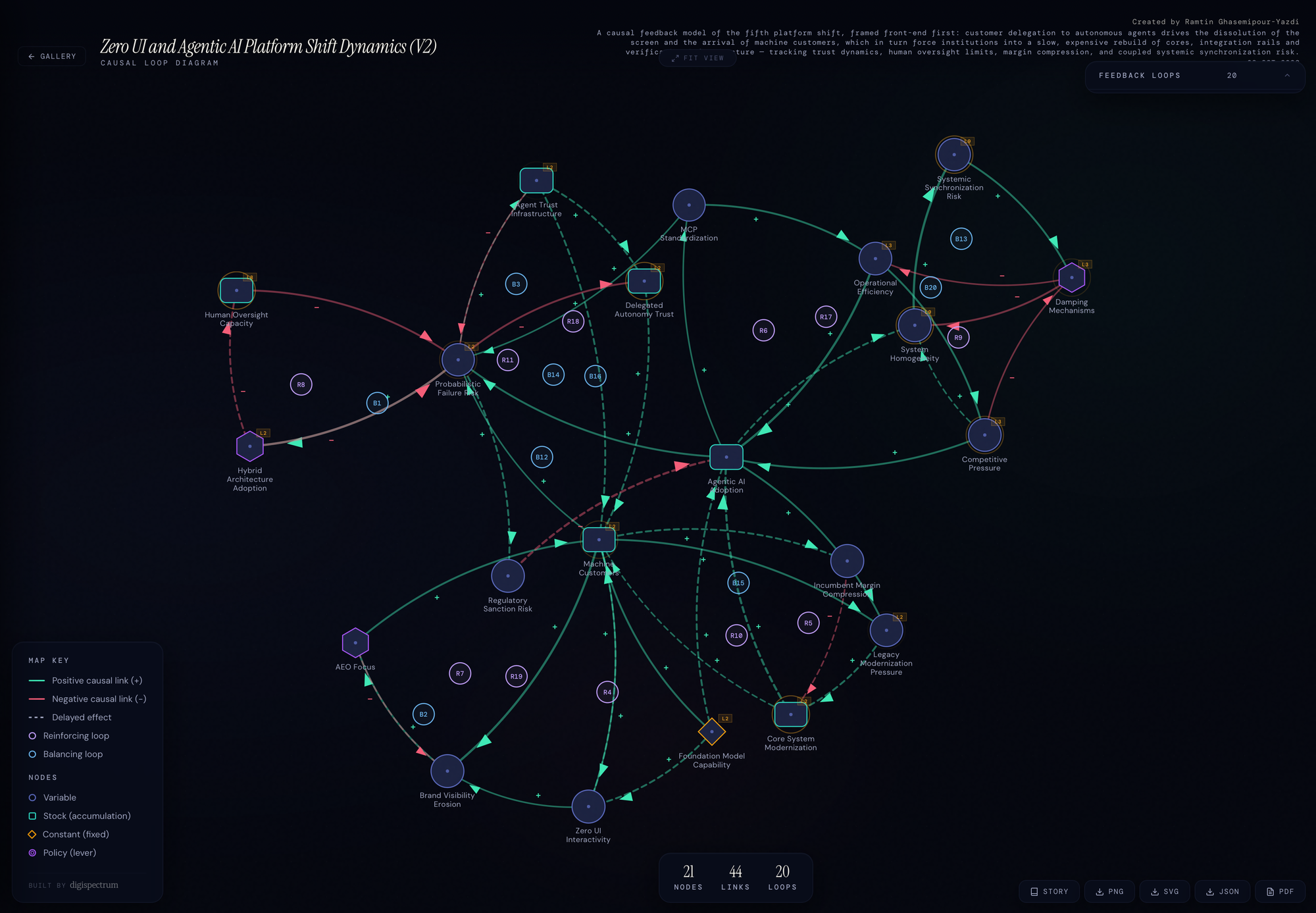
In my causal model, this is the disappearing storefront loop.
The strategic question extends beyond search rankings and AI citations. Who controls the conditions under which an offer is considered, selected, and purchased?
The Platform Behind the Interface
We tend to describe interfaces through what people touch. A keyboard, a mouse, a screen. But an interface also determines how work is divided between a person and a system.
With commands, we specify operations. Graphical interfaces make functions visible and selectable. Touch brings them directly into our hands. With agents, we can express a goal and delegate parts of the planning and execution.
These forms will coexist. Their significance lies in how they change what the underlying platform must support.
The web made software accessible across networks through browsers. Mobile computing brought services into everyday situations, with location, notifications, and continuous connectivity. Those changes reached into architecture, distribution, and business models.
I see agentic computing as a possible fifth platform shift, following mainframes, personal computers, the web, and the mobile/cloud era. The boundaries overlap. The useful question is what a new pattern of use demands from the systems beneath it.
This time, the platform gets a new kind of user. Software acting on someone’s behalf.
A human using an application supplies much of the coordination. We choose the next step, carry information between services, interpret a confirmation, or notice that something has gone wrong.
When we delegate, those responsibilities have to be carried elsewhere.
An agent needs to discover what a service can do, understand the information it requires, establish permission, and interpret the result. It may combine several providers into a journey that none of them designed individually.
A screen can explain a service to a person. The platform must also make that service usable by another system.
This changes the unit around which we design. A human session has a beginning, a sequence of interactions, and an end. A delegated task might continue after we leave, wait for a condition to change, consult several services, and return only when a decision is needed.
“Show me available appointments” and “Arrange an appointment that fits these conditions” place very different demands on the same business.
The consequences reach beyond adding an AI assistant to an existing application.
Platforms must support reliable actions, explicit permissions, shared state, and recovery when execution is interrupted. More parallel checks and retries may increase activity even when customer numbers remain unchanged.
The customer experiences fewer steps. The systems serving them may process more.
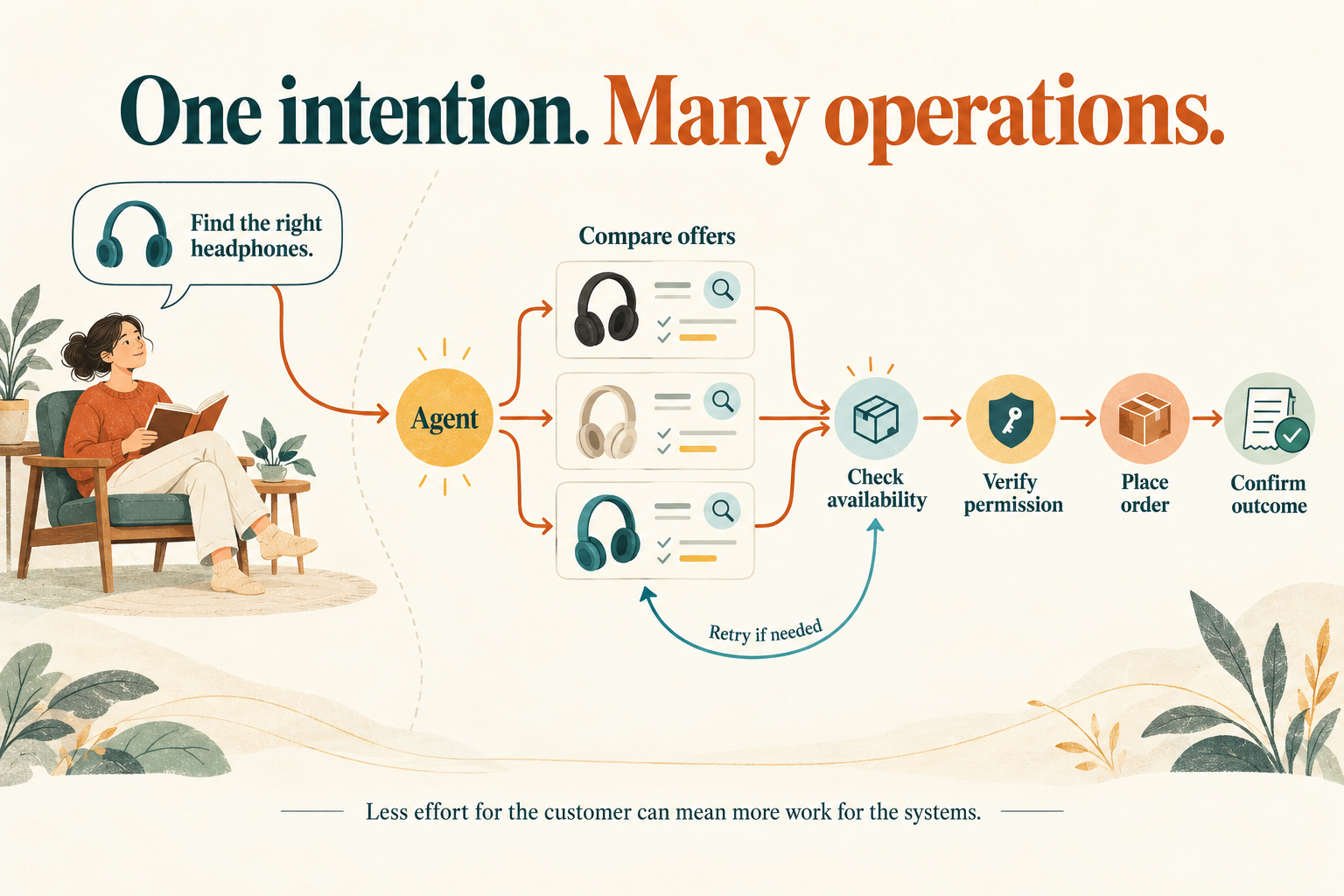
Common protocols are beginning to address parts of this transition. Google’s Agent Payments Protocol, for example, uses digitally signed mandates to provide evidence of what a customer authorised. The important development is the infrastructure for delegated action. Permission must remain verifiable even when a person is absent from individual steps.
Existing systems can provide much of the foundation. The shift does not require every organisation to replace everything. It does require a different design question.
What can our business reliably provide when nobody opens our application?
What the Business Offers
An organisation can use agents to improve an existing workflow. Less manual input, faster processing, better assistance. That is a valuable path of modernisation.
It can also reconsider the product itself.
A scheduling company might add a conversational interface to its calendar. Or it might offer to arrange an appointment across participants, availability, and constraints.
The second possibility changes the promise. The company takes responsibility for coordinating an outcome. It must define what counts as completion, which decisions require approval, and what happens when the arrangement fails.
Its pricing could change with that promise from access to a tool towards payment for a completed service.
This is the distinction between modernisation and transformation. One improves how the existing offer works. The other reconsiders what is being offered, to whom, and under what responsibility.
Both can be appropriate. Transformation is no guarantee of a better business. But treating Zero UI purely as an interface improvement can prevent us from seeing the choice.
There is also a difficult transition to finance. Easier comparison may weaken margins supported by customer laziness, just as agent access requires additional investment.
The transition can reduce the funds available to finance itself.
And customers may move before providers are ready. Trying an external agent can take an afternoon. Adapting core systems and operating processes can take years.
An internal AI roadmap cannot set the timetable for changes already arriving through the customer.
For leaders, the starting point is therefore one customer intention. Follow it beyond the current interface.
What will the person still want to decide? What can an agent undertake? What must the platform make possible and what could the business offer as a result?
These questions bring marketing, technology, and business design into the same conversation.
Return to the bazaar.
The merchant first notices that the customer no longer visits. Eventually, he must consider how the buyer selects suppliers, how orders arrive, what evidence establishes trust, and which services make his business worth choosing.
The change begins at the entrance and reaches into the organisation of the market.
Zero UI carries the same possibility. Agents change how customers choose a business. They also change what that business must be capable of providing.
Its promise is to give people back their attention. Fulfilling that promise requires preserving their ability to understand consequential choices, change instructions, challenge outcomes, and choose another representative.
The merchant’s challenge began when the customer stopped visiting. What followed reached into every part of his business.
As customers delegate, we face the same question. Aare we improving the interface they are leaving behind, or building the business their agents will need?
Author’s note on systems thinking
This article builds on my Zero UI keynote and the causal model “Zero UI and Agentic AI Platform Shift Dynamics,”which maps 21 variables, 44 causal links, and 20 feedback loops. It explores how customer delegation interacts with platform modernisation, brand visibility, trust, human review capacity, competition, and systemic risk. The model is a framework for exploring possible consequences, not a quantified forecast.
If you are observing these changes in your organisation, I would welcome the opportunity to compare experiences. Where is your customers’ journey already moving beyond the systems you designed to support it?